
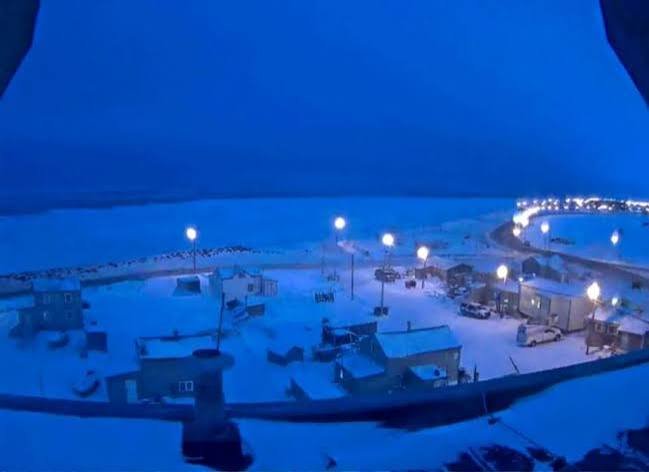
The residents of Utqiagvik, a town in northern Alaska, are preparing for an unusual natural phenomenon as the community enters a period of 65 days without sunrise.
The extended darkness, known as polar night, begins on November 18 and continues until January 22. During this period, the sun will remain below the horizon, leaving the town without a traditional sunrise for more than two months.
Utqiagvik, formerly known as Barrow, is the northernmost city in the United States and is located above the Arctic Circle. Its geographical position causes dramatic seasonal changes in daylight throughout the year.
During summer, the town experiences the opposite phenomenon, known as the midnight sun, when the sun remains visible for weeks without setting.
Although the sun will not rise during the polar night, the town will not remain completely dark throughout the day. Residents can still experience several hours of twilight, depending on weather conditions.
The extended darkness also brings extremely cold temperatures, strong winds and challenging weather conditions. Residents rely on artificial lighting and carefully planned daily routines to manage life during the winter months.
Polar night is a natural astronomical phenomenon that occurs in regions inside the Arctic and Antarctic Circles because of Earth’s axial tilt.
The annual event attracts scientific interest and highlights how Earth’s position and rotation create some of the planet’s most unusual seasonal conditions.
