
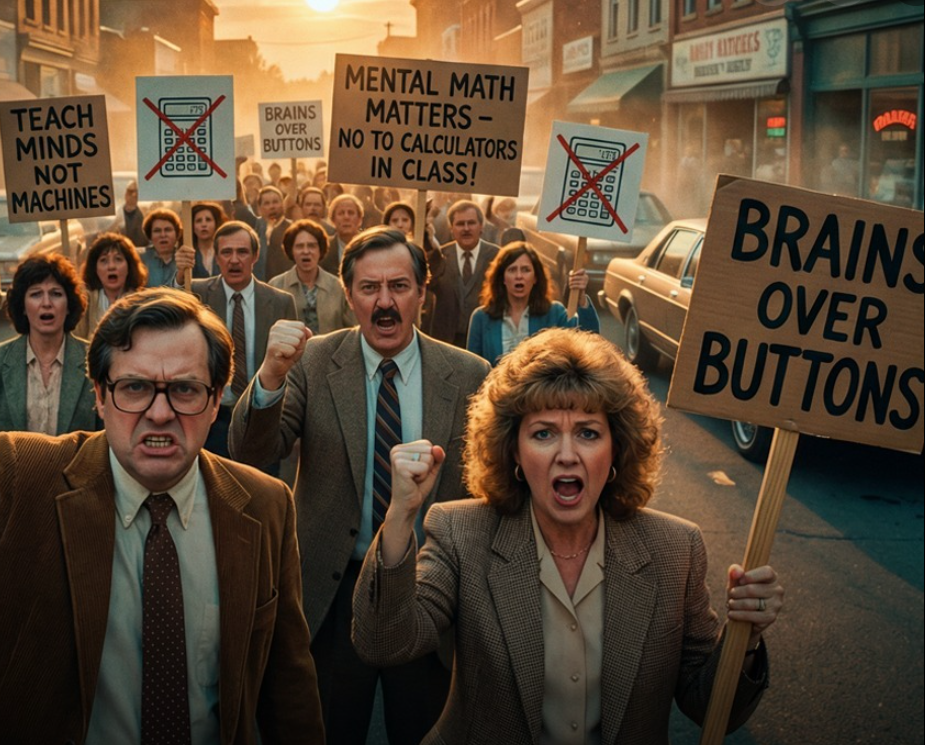
In April 1986, a small but vocal group of math teachers gathered outside a major education conference in Washington, D.C., to protest the growing use of calculators in classrooms.
At the time, schools across the United States were beginning to introduce calculators at earlier grade levels, a move that worried many educators.
The protest was led by well-known math educator John Saxon, who believed students were being pushed toward technology before mastering the basics. The teachers argued that early dependence on calculators could weaken core skills such as addition, subtraction, multiplication, division, and mental math. They feared students would know how to press buttons but not understand how numbers actually work.
Protesters carried signs with clear messages. One of the most notable read, “The Button’s Nothin’ ’Til the Brain’s Trained.” Their point was simple. Technology should support learning, not replace thinking. According to the teachers, calculators had value, but only after students developed strong number sense and problem-solving ability.
At the time, the protest received mixed reactions. Some educators and policymakers felt calculators could help students focus on higher-level concepts. Others agreed with the protesters, warning that overuse of tools could harm learning in the long run.
Nearly four decades later, the debate still feels familiar. Today, classrooms use tablets, apps, and even artificial intelligence. Yet the core question remains the same. How much technology is helpful, and when does it become a shortcut?
The 1986 protest now stands as an early reminder that education is not just about tools. It is about teaching students how to think, reason, and understand before relying on machines to do the work for them.
