
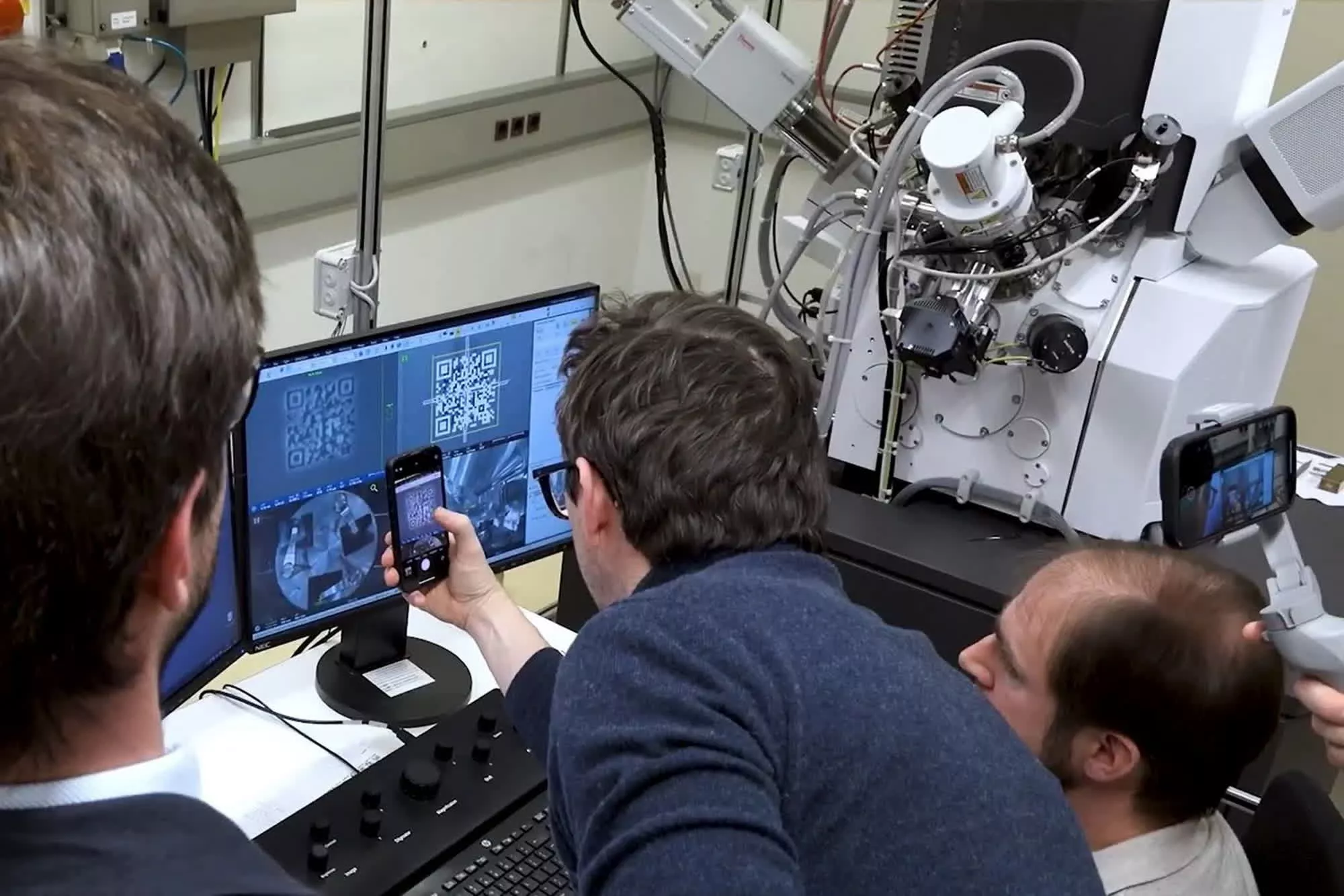
Scientists in Austria have created the world’s smallest QR code, a major step forward for long-term data storage. Researchers from TU Wien (Vienna University of Technology), working with data storage company Cerabyte, made the tiny code that measures just 1.98 square micrometers.
It is smaller than most bacteria and can only be seen under an electron microscope. This achievement has been officially recognised by the Guinness Book of World Records.
The team used a focused ion beam to mill the QR code into a thin ceramic layer, such as chromium nitride. Each pixel is only 49 nanometers wide, about ten times smaller than the wavelength of visible light.
When scanned with an electron microscope, the code successfully links to a TU Wien webpage. It was created and read in front of witnesses to confirm the record.
This technology is not just about size. The ceramic material is extremely durable and stable. Unlike hard drives, tapes or optical discs, it needs no electricity to keep data safe.
Researchers say the ceramic can preserve information for thousands or even millions of years without degrading. On an area the size of one A4 sheet of paper, more than two terabytes of data could be stored using this method.
The innovation has already attracted interest from big tech companies and data centres looking for energy-efficient, long-lasting storage solutions.
While the technology is still being developed, it offers hope for archiving important digital records far into the future. This tiny QR code proves that very small things can solve very big data storage problems.
