
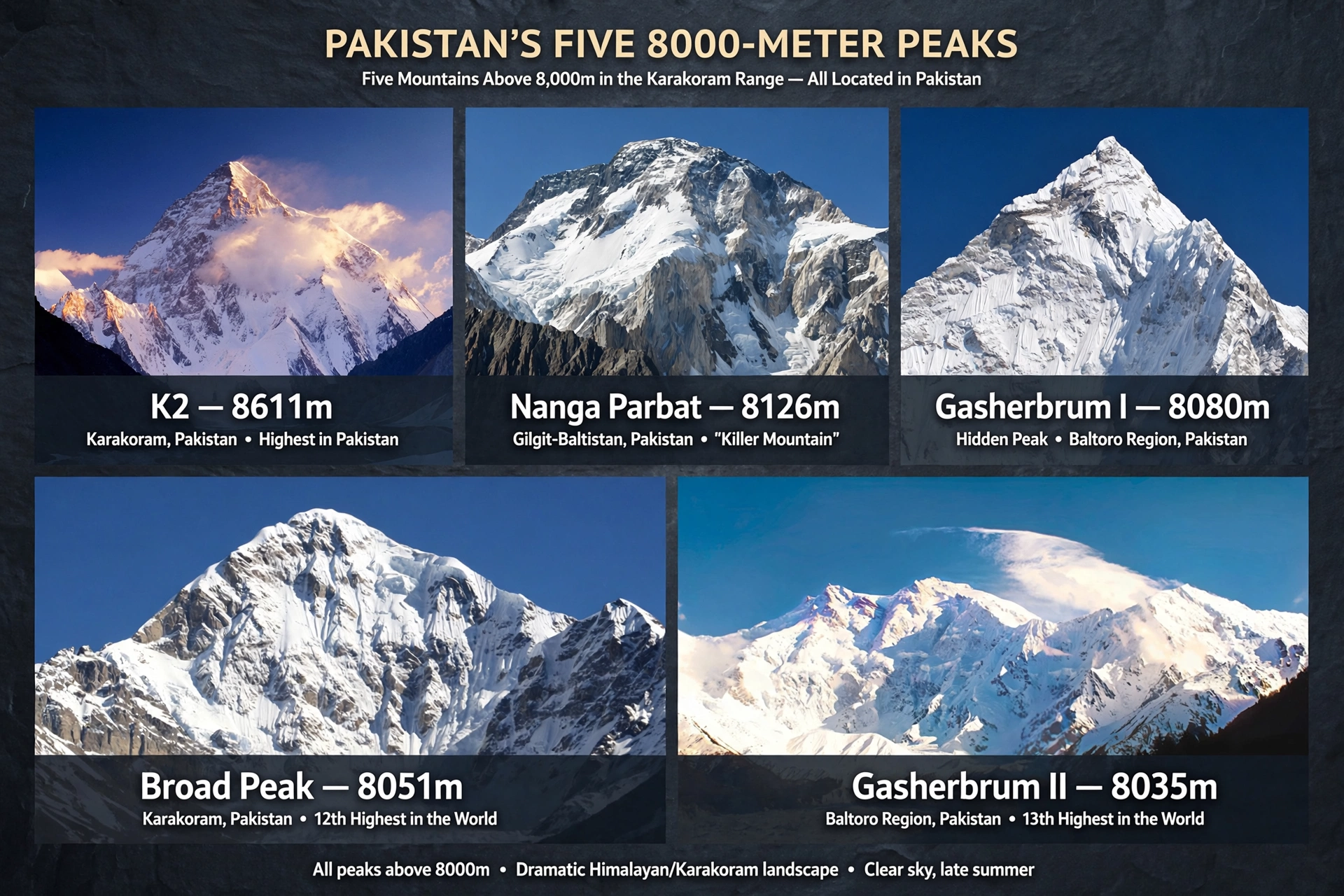
Pakistan is home to five towering mountain peaks that rise above 8,000 metres, placing the country among the world’s most important destinations for high-altitude mountaineering. These spectacular mountains are part of the Karakoram and Himalayan ranges and attract climbers and adventure enthusiasts from around the globe.
The country’s highest and most famous peak is K2, standing at approximately 8,611 metres above sea level. Located in the Gilgit-Baltistan region, K2 is the world’s second-highest mountain after Mount Everest and is widely regarded as one of the most challenging peaks to climb.
Pakistan’s other four 8,000-metre peaks are Nanga Parbat (8,126m), Gasherbrum I (8,080m), Broad Peak (8,051m), and Gasherbrum II (8,035m).
Nanga Parbat, known as the “Killer Mountain,” is located in the western Himalayas and is the ninth-highest mountain in the world. Meanwhile, the Gasherbrum peaks and Broad Peak are situated in the Karakoram, an area renowned for its dramatic landscapes and demanding climbing routes.
The presence of five peaks above 8,000 metres gives Pakistan a unique position in global mountaineering. These mountains also contribute to the country’s tourism potential, attracting international climbers, trekkers, photographers and adventure travelers.
Pakistan’s high-altitude regions offer breathtaking scenery, glaciers and some of the world’s most demanding climbing challenges. However, extreme weather, avalanches, altitude sickness and difficult terrain make expeditions particularly demanding.
With five of the world’s 14 peaks above 8,000 metres, Pakistan remains a major destination for high-altitude mountaineering and adventure tourism. The mountains are not only a source of national pride but also represent significant opportunities for tourism and local economic development.
