
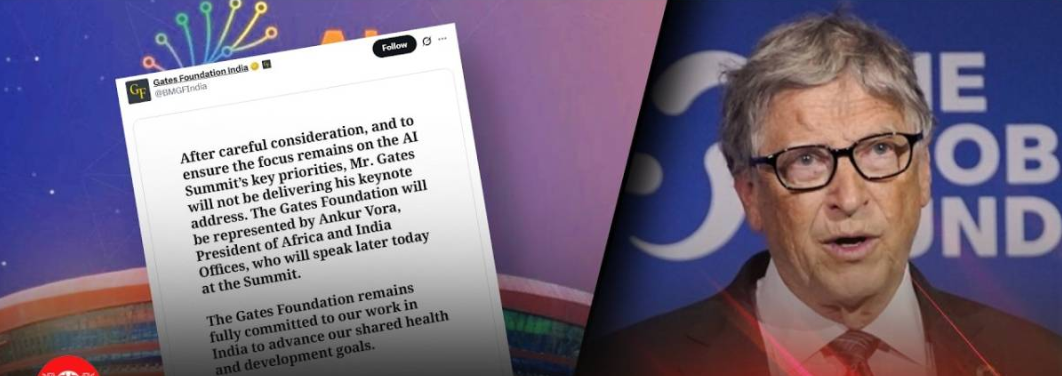
Bill Gates withdrew from India’s AI Impact Summit just hours before he was scheduled to deliver his keynote address, adding to growing concerns over the event’s organisation. His decision followed the earlier exit of Jensen Huang, whose absence had already raised questions about coordination at the high profile gathering.
The Gates Foundation stated that Gates stepped back to ensure the focus remained on the summit’s core priorities rather than logistical disruptions. Reports from attendees pointed to significant traffic congestion and road closures around the venue, forcing participants to walk long distances to access the site. An exhibition display featuring a robotic dog by an Indian university also drew criticism online, adding to the controversy.
The summit aimed to position India as a major player in artificial intelligence investment and innovation. Narendra Modi, addressing participants, emphasized the need to prioritize children’s safety and ethical safeguards in AI development. Meanwhile, opposition parties criticized the event’s management, calling the planning inadequate for a summit of such scale.
Despite the setbacks, organizers announced that more than 100 billion dollars in AI related investments had been pledged, with projections suggesting commitments could cross 200 billion dollars. Analysts, however, caution that infrastructure readiness, regulatory clarity, and urban capacity will be critical if India is to sustain large scale AI expansion.
The episode highlights the growing scrutiny global tech events face as artificial intelligence becomes central to economic strategy and public policy.
