
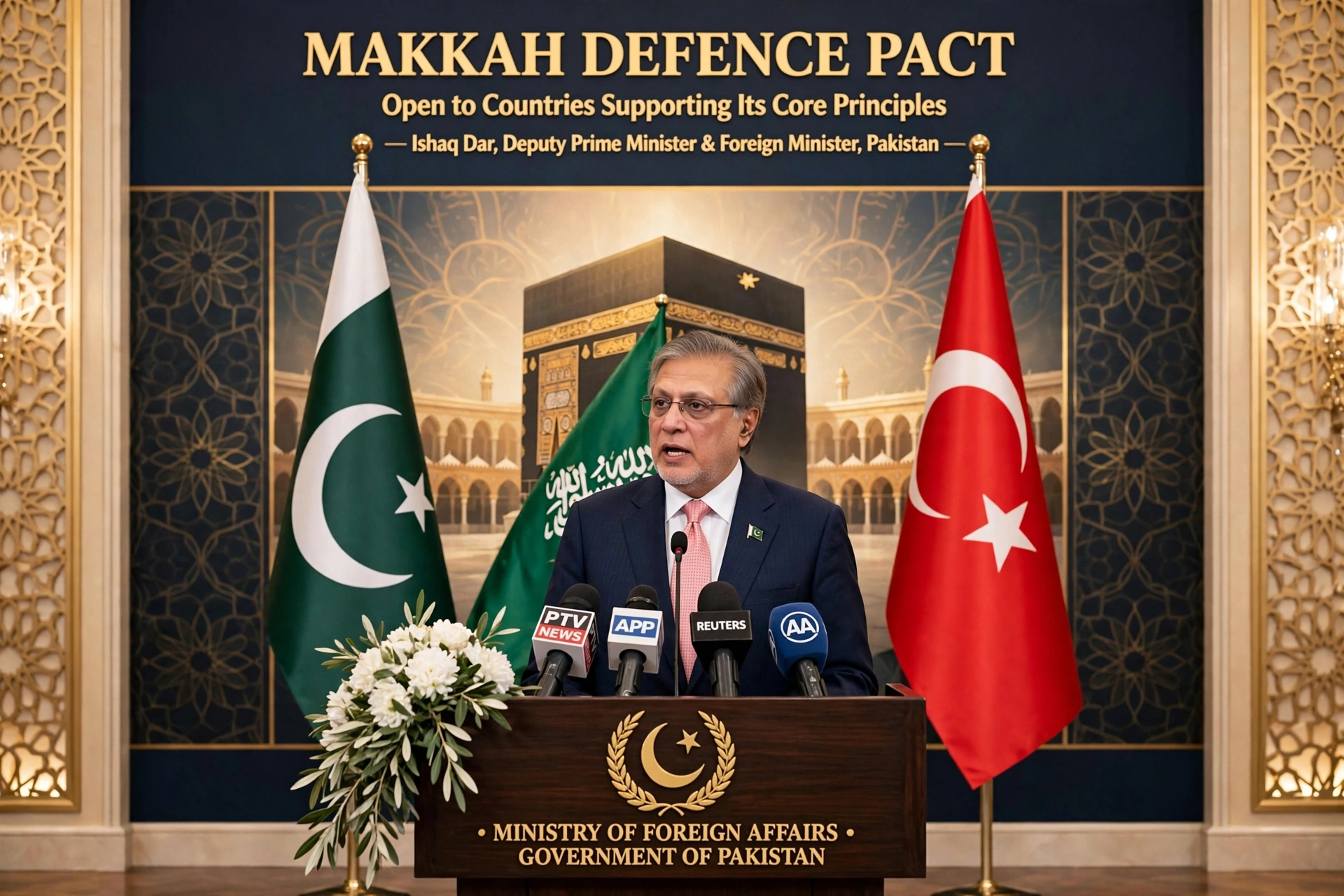
Pakistan’s Makkah Defence Pact remains open to other countries that support its core principles, Deputy Prime Minister and Foreign Minister Ishaq Dar has said, signalling the possibility of a broader regional security partnership.
Dar said the agreement is defensive in nature and aims to promote peace, stability and prosperity across the region. His remarks came after Pakistan, Saudi Arabia and Türkiye signed a joint defence agreement designed to strengthen security cooperation among the three countries.
Under the pact, an armed attack against any one of the three signatories would be regarded as an attack against all, creating a collective security framework between the participating states.
The agreement marks a significant development in relations between Pakistan, Saudi Arabia and Türkiye, with the three countries seeking closer coordination on defence and regional security matters. Officials have stressed that the arrangement is focused on deterrence and collective defence rather than aggression.
Dar’s comments indicate that the agreement could potentially expand beyond its founding members. Countries that share its principles and objectives could have an opportunity to join the framework in the future, subject to agreement among the participating states.
The development comes as regional countries increasingly seek stronger strategic cooperation and mechanisms to address common security challenges. Pakistan has maintained longstanding defence and diplomatic ties with Saudi Arabia and Türkiye, while cooperation between the three countries has expanded across economic, political and security sectors.
The pact could provide a platform for the members to coordinate positions on regional security issues while enhancing defence cooperation and strategic preparedness.
For Pakistan, the agreement further strengthens its relationship with Saudi Arabia and deepens its strategic partnership with Türkiye. Its potential expansion could make the framework an important part of a wider regional security architecture focused on collective defence, stability and peace.
