
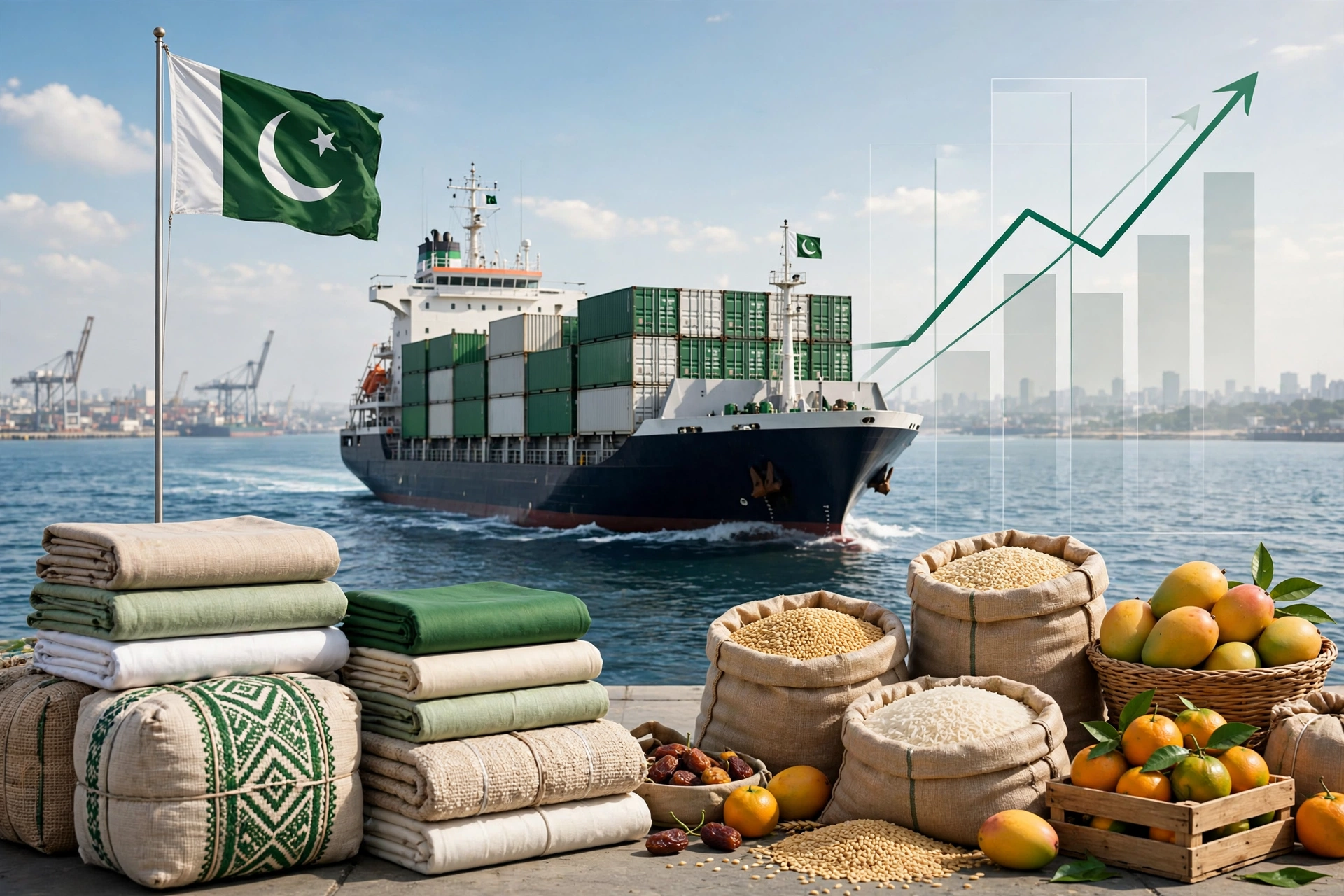
Pakistan aims to increase its exports to $100 billion by 2035 as the government seeks to reduce dependence on foreign borrowing, strengthen economic stability and achieve long-term financial independence.
Federal Planning Minister Ahsan Iqbal announced the target on October 14, 2026, while addressing the 39th International Conference and Annual General Meeting of the Pakistan Society of Development Economists (PSDE) in Islamabad. He said expanding exports was essential to breaking the country’s recurring cycle of economic dependency and balance-of-payments crises.
The minister stressed that Pakistan must move away from consumption-driven growth towards a production- and export-led economic model. He explained that when economic growth relies heavily on imports without generating sufficient foreign exchange, the country faces pressure on its currency and becomes more dependent on external financing.
According to figures cited by Ahsan Iqbal, Pakistan’s goods exports stood at approximately $32 billion in 2024. In comparison, Bangladesh recorded around $47 billion, while Malaysia and Vietnam achieved approximately $330 billion and $404 billion, respectively.
To achieve the ambitious target, the government plans to improve industrial productivity, modernise manufacturing, encourage investment and expand access to international markets. Greater value addition in textiles, agriculture, information technology and other export-oriented industries will be important to increasing foreign exchange earnings.
The minister also emphasised the need for consistent economic policies beyond political transitions, arguing that businesses require stability and long-term planning to compete internationally.
Pakistan’s export strategy is also linked to the broader URAAN Pakistan framework, which seeks to transform the country’s economic structure and support sustainable development.
Achieving $100 billion in exports by 2035 would represent a major expansion of Pakistan’s international trade. However, reaching the goal will require sustained reforms, competitive energy costs, improved infrastructure, technological advancement and stronger integration into global supply chains.
