
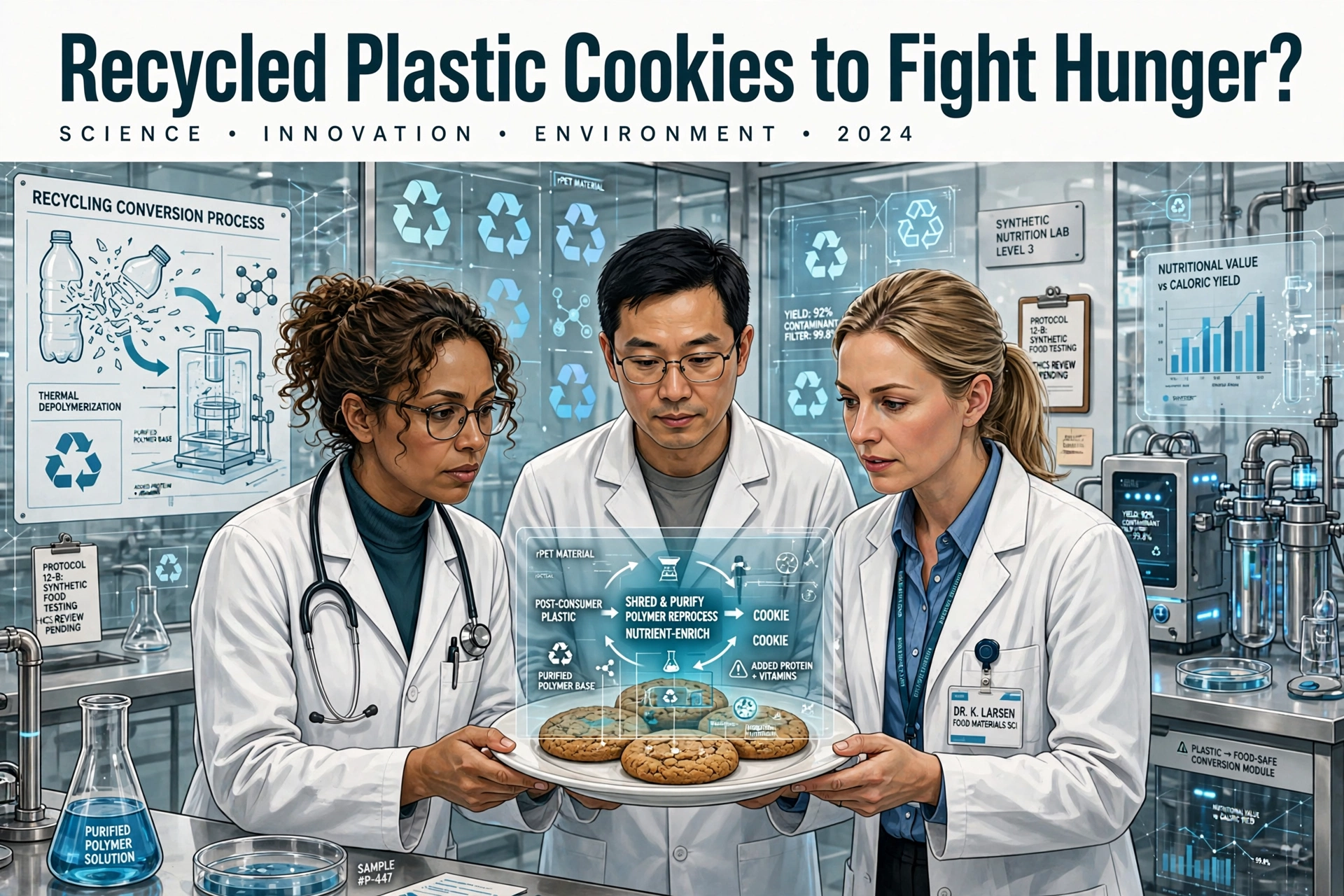
Scientists have developed an unusual food technology that could one day turn plastic waste and agricultural leftovers into nutritious cookies, offering a potential solution to both pollution and food shortages.
Researchers at Southern Illinois University Carbondale created experimental cookies called µBites as part of work supported by NASA’s Deep Space Food Challenge. The project was originally designed to explore new ways of producing food for astronauts during long-duration space missions.
The process does not simply put pieces of plastic into food. Researchers first break down PET plastic, commonly used in water bottles, using heat, water, oxygen and pressure. The resulting carbon-rich material is then fed to specially engineered yeast, which converts it into useful biological ingredients such as proteins, fats, vitamins and flavour compounds.
The resulting mixture is combined with other ingredients and shaped into cookies using a 3D food printer. Researchers have also developed yeast strains capable of producing vanilla flavouring and other food components.
The technology could eventually have applications beyond space travel. Scientists say portable systems could potentially produce food in disaster zones, submarines and remote environments where conventional food supplies are difficult to maintain. It may also help address the growing challenges of food insecurity and plastic waste.
However, the cookies are still experimental. Researchers have not yet eaten them, as safety testing and approval for human trials are still required.
If successfully developed, the technology could offer a remarkable future where waste is transformed into food instead of ending up in landfills.
