
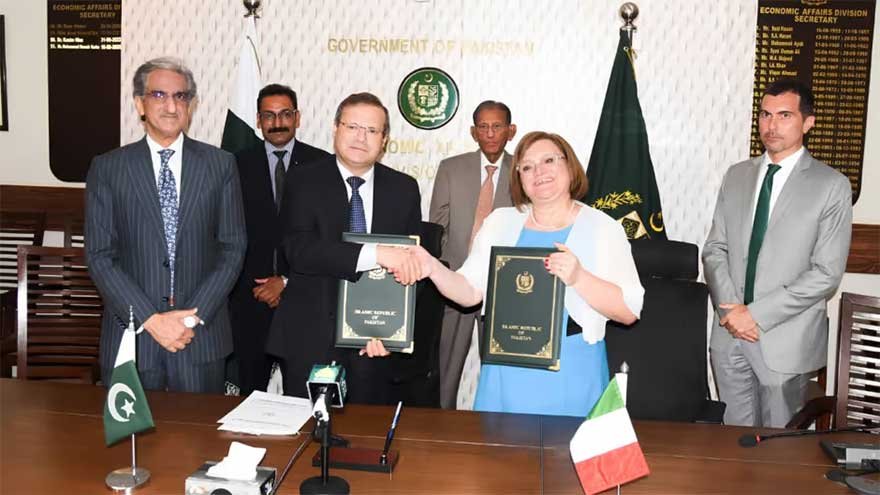
Italy and Pakistan signed a €20 million concessional loan on Monday, June 29, 2026, which works out to roughly Rs 6.3 billion.
Economic Affairs Secretary Muhammad Humair Karim and Italian Ambassador Marilina Armellin signed the deal in Islamabad, joined by officials from the Italian Agency for Development Cooperation, the Ministry of National Food Security & Research, and provincial agriculture departments.
The funds will support the Professional Capacity Building and Extension in Agriculture project, part of Pakistan’s Technical and Vocational Education and Training National Reform Programme.
Over the next 42 months, the program will run 720 training courses across the country. The focus is on high-value crops that can raise farm incomes: olives, pistachios, dates, mushrooms, cherries, grapes, peaches, and almonds.
Training will target farmers, extension workers, trainers, and others in the agriculture chain.
The idea is to replace outdated methods with modern, demand-driven skills and internationally recognized certification. That should help boost productivity, introduce sustainable farming practices, and create better livelihoods in rural areas.
This agreement is separate from the older Pakistan-Italian Debt Swap Agreement that began in 2006. That debt-swap converted about $100 million of Pakistan’s debt into projects on health, education, and agriculture.
The new Rs 6.3 billion is fresh money, not a debt write-off, and it’s ring-fenced for vocational education only.
For everyday Pakistanis, the impact shows up in three ways: young people in villages can get certified agri skills for jobs or their own farms, farmers can shift to higher-value crops with better returns, and the TVET system itself gets stronger long after the 42-month project ends.
