
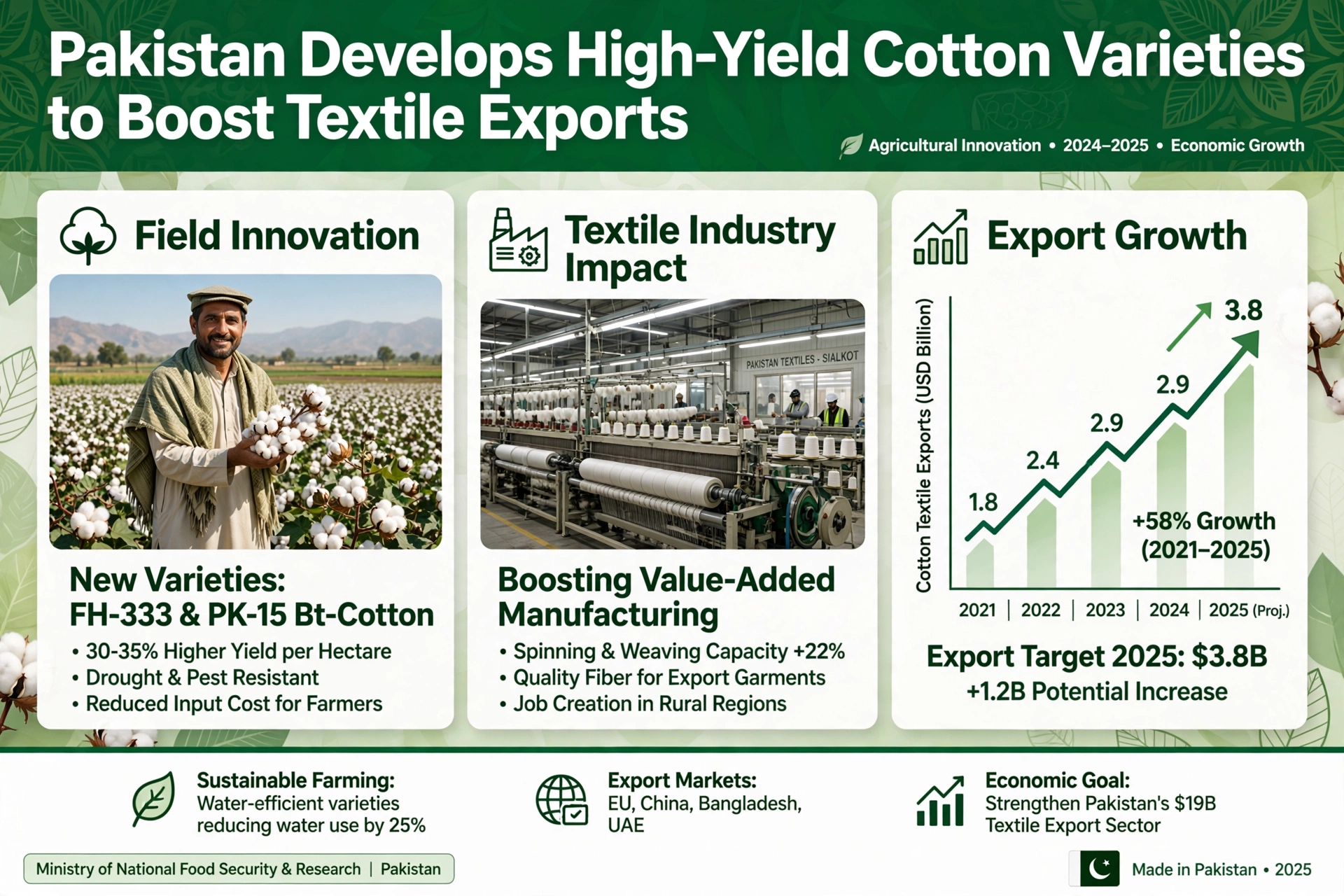
Pakistan is stepping up efforts to revive its struggling cotton sector by developing and promoting high-yield, pest-resistant and climate-resilient cotton varieties, with the broader objective of strengthening the country’s textile industry and export capacity.
The initiative comes at a critical time for Pakistan’s cotton economy. Cotton production has fallen sharply from its historical peak, with output estimated at around 6.85 million bales in 2025–26, significantly below the government’s target of 10 million bales. The decline has increased the textile industry’s dependence on imported cotton and contributed to billions of dollars in additional import costs and lost export earnings.
Researchers and agricultural authorities are focusing on varieties that can deliver higher yields while offering greater resistance to heat, pests and diseases. The Central Cotton Research Institute (CCRI) in Multan, for example, has developed varieties featuring heat tolerance, early maturity, high yields and improved fibre characteristics.
Punjab has also approved BT CIM-990, a high-yield, virus-resistant variety developed by CCRI, highlighting the growing emphasis on improved seed technology. Farmers have additionally been encouraged to cultivate approved triple-gene cotton varieties to improve productivity and pest resistance.
Improving domestic cotton production could directly support Pakistan’s textile exports, as the industry requires a reliable supply of quality local fibre. Higher yields would reduce the need for imported raw cotton while helping mills maintain competitive production costs.
The government is also pursuing wider measures to revitalise the sector, including regenerative agriculture, improved seed quality and stronger research collaboration between policymakers, researchers and industry stakeholders.
With cotton remaining a crucial input for Pakistan’s textile industry, the successful commercialisation of improved varieties could help farmers increase productivity while supporting the country’s efforts to expand value-added textile exports and reduce its import burden.
