
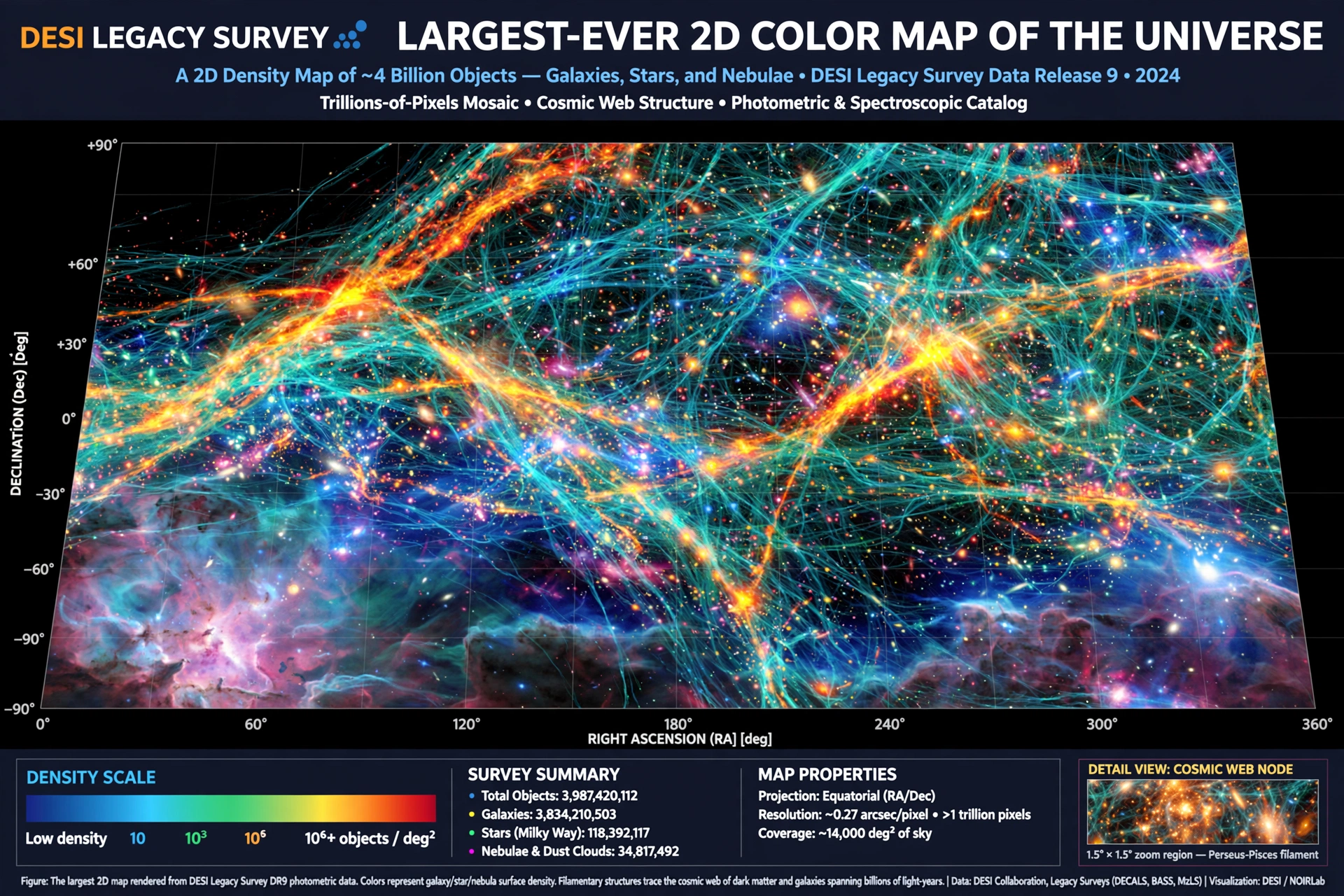
Scientists have unveiled what is being described as the largest-ever two-dimensional color map of the universe, providing an extraordinary view of billions of celestial objects spread across a vast portion of the night sky.
The enormous map contains nearly 4 billion stars, galaxies and other celestial objects and consists of approximately 5.6 trillion pixels. It was assembled using data from more than 263,000 telescope exposures, creating an unprecedented visual record of the observable cosmos.
Covering roughly 75% of the sky, the map allows researchers to examine distant galaxies and stars on a scale that was previously difficult to achieve. By combining hundreds of thousands of observations, scientists have created a detailed dataset that can serve as a valuable resource for future astronomical research.
Beyond its visual significance, the project could help researchers investigate some of the biggest unanswered questions in modern cosmology. Scientists can use the data to study dark matter and dark energy, two mysterious components believed to play major roles in the structure and evolution of the universe.
The map may also help researchers identify and analyze gravitational lenses, where massive objects bend light from more distant objects behind them. Such observations can provide important information about the distribution of matter throughout the universe.
In addition, the dataset can support research into supernovae and the expansion of the universe, helping scientists improve their understanding of how the cosmos has evolved over billions of years.
The massive astronomical resource represents a major achievement in observational science. By bringing together billions of celestial objects in a single extensive map, researchers now have a powerful new tool for exploring the universe and investigating its most fundamental mysteries.
